Journal of Islamic Sciences
  • Science
    • Conversations
    • Epistemology
    • Philosophy
    • History
  • Origins
    • Cosmos
    • Life >
      • Creation
      • Evolution
  • Qur'an
    • Qur'an and Science
    • Qur’anic Studies
    • Qur'anic Worldview
  • Islam
    • Economics
    • Education
    • Islamic Studies
    • Environment
  • Reflections
    • Shudhur
    • Obituaries
  • Scholars
  • About
    • Editors & Editorial Board
    • Authors
  • Subscribe
  • Current
  • Archives
  • Science
    • Conversations
    • Epistemology
    • Philosophy
    • History
  • Origins
    • Cosmos
    • Life >
      • Creation
      • Evolution
  • Qur'an
    • Qur'an and Science
    • Qur’anic Studies
    • Qur'anic Worldview
  • Islam
    • Economics
    • Education
    • Islamic Studies
    • Environment
  • Reflections
    • Shudhur
    • Obituaries
  • Scholars
  • About
    • Editors & Editorial Board
    • Authors
  • Subscribe
  • Current
  • Archives

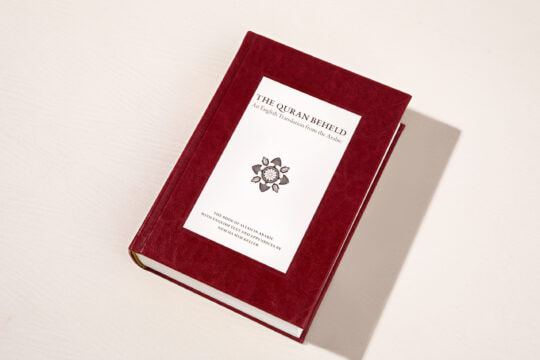
Book Review: Nuh Ha Mim Keller: The Qurʾan Beheld​
Picture

Nuh Ha Mim Keller’s 15-year journey of the impossible task of translating the Qurʾan culminates with the claim that this translation is superior to all the 135 existing translations. This is a rather tendentious claim, not least because there are multiple ways of judging a translation of the untranslatable Qurʾan. The claim that this translation surpasses every one of the existing 135 translations is based on the authority of the translator’s wife and Professor Ahmad; it is unlikely to pass the test of objectivity, especially when-unlike the well-grounded oral Arabic explanations of ʿAli Hani’s, some of which have been uploaded to the project website-there is no documented evidence of the scholarly accomplishments of the translator’s wife and Professor Ahmad does not seem to have published his article, nor is he known as a scholar of Qurʾan or its translations.
 
When one finally starts to read the translation in The Quran Beheld, one realizes that the text is actually a mini-tafsir and not a translation, a tafsir, moreover, that is random, incoherent, and utterly devoid of beauty and serenity of the original. Its convoluted English often fails to convey even the basic meaning of the Qurʾanic text.
​
Examples:


Q 1:2 is translated as “All praise is Allah’s, Lord of all Worlds of Beings.” The passive All praise is Allah’s and mistranslation of ʿAlamin stand out immediately. In almost every tafsir, ʿAlamin is defined as everything other than Allah Most High (see Tafsirs of Ṭabari, Samarqandi, Razi, Baydawi, sub Q 1:2). The meaning of the verse is conveyed by simply saying, “Lord of all the Worlds”; the addition of “Beings” is redundant.
Q 1:5 is translated in plain gibberish:  “You alone we humbly adore and in You alone we seek help. Semantic fields of naʿbudu (from the root ʿ-b-d) and “adore” are irreconcilably different.
Q 1:6, “Guide us the Straight Way”, is a verbatim replication of Muhammad Asad’s equally flawed translation.
Q 1:7, The way of those You have divinely blessed, who have not then incurred wrath, or utterly lost the way, unnecessarily adds “divinely”; “then” is not in the original, “utterly lost the way” is a poor rendering of dalin.
Q 11:27: “Whereupon the nobles who disbelieved of his people said: ‘We see none following you but our despicable poor, At their first unthinking whim; Nor see we in any of you the slightest merit over us; But, rather, we deem you liars.’” Problems with the syntax of “the nobles who disbelieved of his people” is obvious; meaningless verbosity (“unthinking whim”), and inaccuracy of “slightest merit” for min fadl, and the loss of kinetic force of the original are too obvious to comment.

Read More…


Journal of Islamic Sciences, Vol. 16 (Summer 2003) No. 1

PDF
Picture

Muzaffar Iqbal

Muzaffar Iqbal is the President of the Center for Islamic Sciences and the General Editor of the Integrated Encyclopedia of the Qurʾan.

Picture
© Center for Islamic Sciences. All Rights Reserved.
​​Designed and Developed by Crescent Marketing Solutions