In the Beginning: Islamic Perspectives on Cosmological Origins—I
DOI:
https://doi.org/10.66207/jis.v4i1.65Keywords:
Cosmology, sacred cosmology, the Beginning and the End, the Guarded Tablet and the Pen, the Throne and Footstool, creation theme in the QurnAbstract
How did the cosmos come into existence? When? Is there an end to this beginning? Cosmology, the sci- ence which studies the creation of the cosmos, can be divided into several categories. Philosophical reflec- tion on the origins created a tradition of philosophical cosmology. Pythagoras, Plato, Aristotle, and a host of other philosophers have left detailed accounts of their opinions about the creation of the cosmos. Most of this philosophical cosmology was translated into Arabic, leading to the emergence of an Islamic philosophical cosmology which started to move away from the Greek tradition in the eleventh century; this move achieved a definitive character in the form of ikmah (Wisdom tradition) in the thirteenth century. This tradition re- mains alive in contemporary Islamic thought. Before the emergence of the Islamic philosophical cosmology, however, there existed another cosmological tradition, the “Sacred Cosmology”, based on the Qurnic de- scriptions of creation and on the sayings of the Prophet. Based on the earliest sources, this paper, the first in- stallment from a chapter of a work in progress, explores three aspects of this Sacred Cosmology: those deal- ing with the Guarded Tablet and the Pen; the Throne and the Footstool; and the Heavens and the Earth.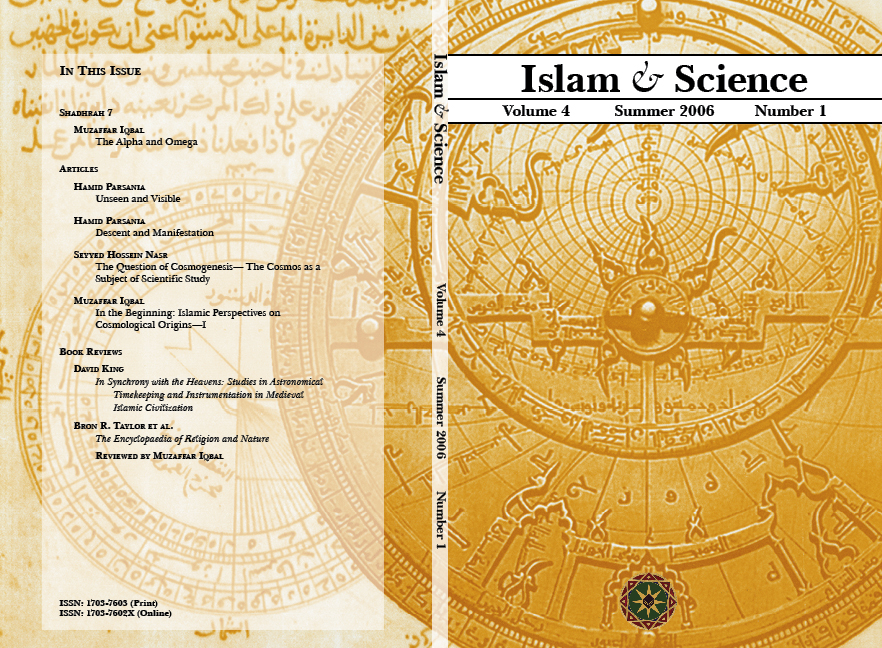
Downloads
Published
2006-06-01
Issue
Section
Articles
How to Cite
In the Beginning: Islamic Perspectives on Cosmological Origins—I. (2006). Islamic Sciences, 4(1), 61-78. https://doi.org/10.66207/jis.v4i1.65